Prologue
I have never travelled by myself anywhere, certainly not somewhere as far as Beanibazar. When you come from a sheltered family like mine, travelling with company is always a must, at least a pair of two. Yet, here I was, preparing to journey to my ancestral village. My dada bari. On my own. For the first time.
I shall admit, I was surprised when I first found out about the plan. My dad being the strict and protective man that he is would never let his daughter travel by herself. He never let any of my four elder sisters either, yet here I was. What has changed?
I stared at the back of my father’s head as he scrolled through his phone while reading different articles on our country’s situation. My father, Harun, has always been very good at hiding his emotions. True emotions to be exact. And by emotions, I mean, I have never seen him cry. Being the short-tempered man that he is, I have seen his fits of rage, and I have seen him smile. But the only time I heard about him genuinely being happy was when my eldest sisters, Sharmin and Shumin were born. Perhaps it was the excitement of having his first children, but the stories I heard of the man he was then resemble nothing to the man I know him as. Almost as if they are different people.
Not to forget, those were stories I heard from my mom, not him. My father has never been the talkative one with his children, let alone make idle conversations. True, he has always done his duties as a father, fed us, clothed us, educated us, raised us. Everything a father was meant to do. But I can’t remember the first or last time I had a decent conversation with him.
“Kun shomoi baraoi bai? (When will you leave?)” My mother asked from the kitchen, walking into the room and placing a cup of milk tea before my father without turning her attention to me, but I knew she was addressing me.
“Ou baroi zaimu. (Just in a bit.)” I replied, watching her gracefully roam around the room before perching like a docile bird across from my father.
She was… rather good at concealing her inner thoughts. She, Fathima, always had a smile on her face, but she did have her moments of rage if we were unruly. However, I could never tell what she really thought now and then, and it made me wonder if she ever thought at all. My mistake, she did think; about Ahmed. Her only son.
A lot.
Ahmed was my mothers greatest joy, just like Shireen, my third sister was father’s greatest pride. They may have felt the greatest when they had their first two children, but the favorites were their third and fourth- Ahmed and Shireen. As for my fourth sister Tarin and myself being the last, I wasn’t sure.
I didn’t know what they thought of me.
“The baroi zao ekhon. Baade der oizibo. (Then you better leave now, lest it becomes late.)” Were my father’s words to me, barely looking up from the phone in hand. But I could sense the concern edged in his voice.
I’m sure they loved me, but sometimes I can’t help but wonder if I was something they considered a gift, a choice, or a responsibility.
I pursed my lips before getting to my feet, smiling at them. “Acha. (Okay.)”
Because when you have a total of six children, the excitement of parenthood already disappears by the time the third or fourth child is born, let alone the sixth child.
Turning to look at my parents sitting across from one another, I knew exactly what they were.
The textbook versions of parents.
To be on Your Own
The journey to Beanibazar was definitely not an easy one, especially when one is traveling all the way from the city to the rural village. But I had to make it anyway. Starting from Shaporan I hailed an auto rickshaw that drove me till the bypass road, from where I then hailed yet another auto rickshaw that took me further inside only to drop me off at Gulapgonj. Every time I finished a trip, I found myself releasing a sigh of relief knowing that I was getting closer and closer without getting abducted or harassed. A girl can never be certain.
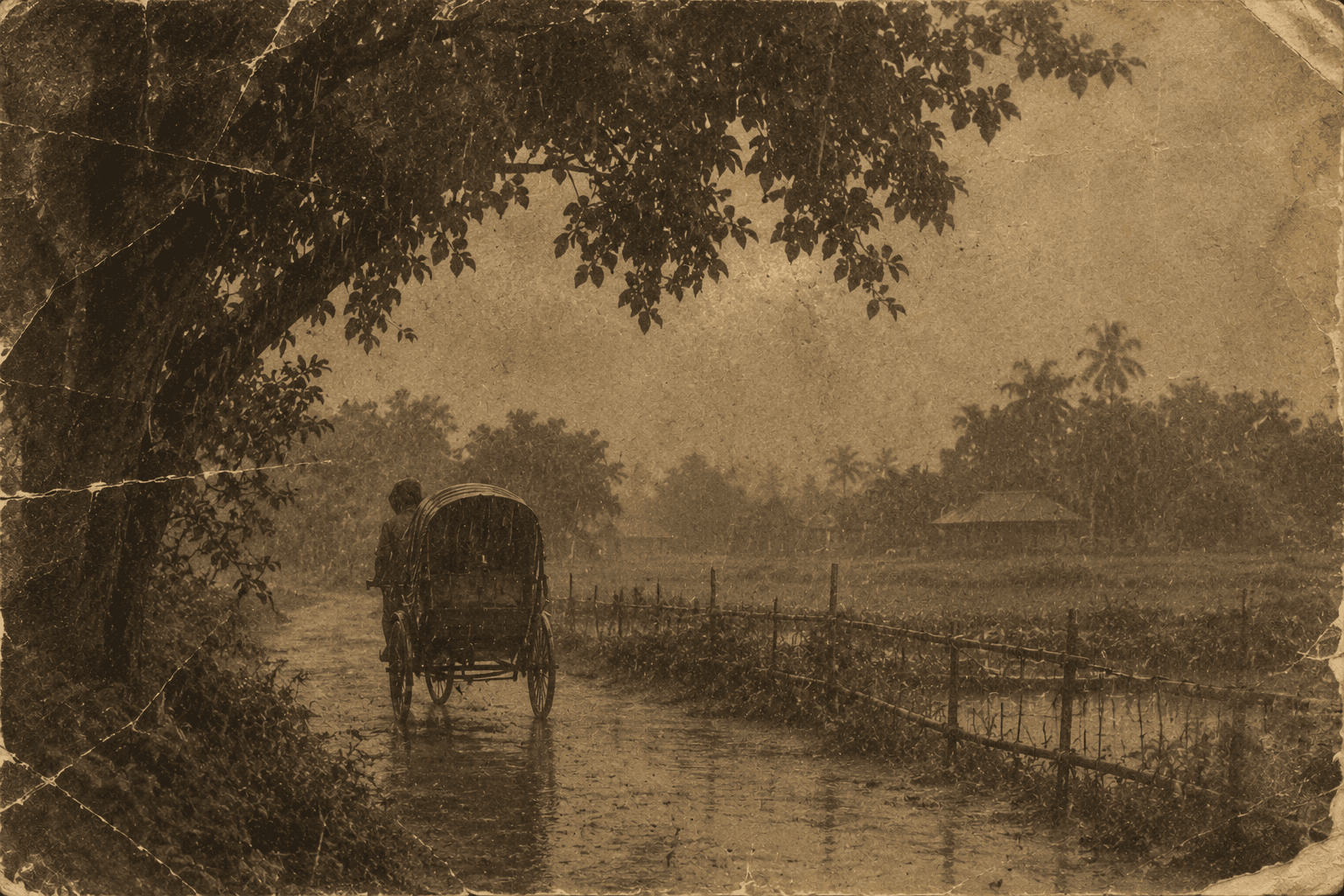
Yet, my journey was far from over, but close nonetheless. I was close to Narafing, and from here on, I could travel via manual rickshaw, which was the part I was looking forward to the most. Riding a rickshaw all by yourself with the wind brushing past your face as it speeds by was a welcoming thought, especially when it was the rural breeze of nature.
“Kano zaitha? (Where to?)” Asked the driver I had managed to hail. My reply was quick. “Beanibazar sinoin ni? (Do you know Beanibazar?)”
“Beanibazar khe na sine? (Who doesn’t know Beanibazar?)”
Right.
“Beanibazar, Ramdabazar, Sondogram?” My attempts at narrowing down my location was laughable. I was only saying names of places registered in my national ID at this point.
“Khano, point o namba ni? (Do you wish to be dropped on the main road?)”
Alright. Here goes nothing. “Khan’s residence sinra ni? (Do you know Khan’s residence?)”
Imagine my surprise when he said he does. This man was a god sent. I was finally saved from further embarrassment.
From then on, the ride was peaceful. The man took his sweet time riding towards my dada bari, while I leaned back and sighed in relief. I was indeed relieved, to the point I found myself feeling drowsy with leftover sleep.
This was not a wise idea, falling asleep in a rickshaw. But somehow, I found myself being lulled to a peaceful sleep, leaving my fate up to the heavens.
I don’t know for how long I slept, or if I had even slept to begin with. All I can say is I had just brushed my eyelids shut, maybe for a minute, or maybe a second, before I felt the rickshaw come to a stop.
“Afa, utokka. Aicchi. (Sister, wake up. We’re here.)”
Already?
My eyelids fluttered open, and true to his words, we had made it. I was right before the massive gates that led to my ancestral home, where my uncles and aunts were still there.
Only that something didn’t seem… right.
The gate seemed so… new. Like it was newly painted. Yet the paint was chipped, but the gate was in better condition than I had last seen it. And the place-
“Afa, bara dibani? (Sister, the fare?)”
Right. The fare- WOAH!
I almost flinched at the sight of the old man before me. Because up until a moment ago, it wasn’t an old man riding me.
Wasn’t it… a middle-aged man? Or did I get it wrong? Did I not look at his face enough?
But then… the rickshaw…
It was manual.
But I remember hailing a motor rickshaw.
What… is going on? Am I dreaming?
The Face of Unfamiliarity
Everything seemed to become a hazy mess before my eyes. I did not know how I paid the man and began making my way forward. All I knew was that my heart was in my throat, and my senses alert to the very strange and unfamiliar scent around me. Almost like it was… ancient.
Nothing felt familiar in this very familiar place. I remember there used to be a grocery shop outside the gates Dola sasa had made. Did they break it down? I don’t know. But the deeper I went, the stranger it got.
Because now I was finally seeing people around, people I call my family. But for some reason, most of them were… children. There were hardly any adults around.
The sound of laughter and giggles grew louder as I drew closer, making my way to a group of children playing on the mud. At the sight of me approaching them, their smiles faltered.
“H-Hi.” I greeted in English like the fool I was.
Silence.
“Umm, ikta kita Khan residence ni? (Is this Khan residence?)”
More silence. Until one of them turned to whisper something in another ear before they jumped to their feet and just like that, they took off. And all I could think was, did I say something wrong?
The kids were gone. Not just the kids I spoke to, but every other kid around as well. The whole place was vacant, like everyone had disappeared at the sight of me. I had no idea what was going on, or if there were any adults, but I needed to find answers. I needed to know where I was because this was certainly not my home. It looked like my home, but it wasn’t home.
--------
“The renovations in Boro sasa’s house are gone. The study room abbu built in our house is gone too. In fact, the bedroom abbu built for Moulana sasa is gone too! And it was constructed two decades ago!” I stopped wherever I was going with a stomp of my foot, unable to believe what I had just seen. “How did everything disappear in less than a year!?”
And the more I think about it, the more it looks odd. I… could not recognize anyone. No matter how little I may have seen of them, I know who my relatives are! There is no way they all just disappeared into thin air and were replaced by children I never saw over there in my life!
So caught up in my train of thoughts, it takes me a while to realize I’m no longer in the Khan residence territory. I was somewhere else, like a rice field.
“Great. Now where the hell did I-”
Until I saw him. A young boy. In the rice field.
Sitting there all by himself, staring into the distance while being surrounded by cows and calves of all sizes. There he was, all alone in that massive watery field, with nothing but his cattle as company. And he looked so… peaceful.
Who are you? And why do you look so familiar?
I did not have long to dwell on it, because just then, my heart leaped out of my chest.
BANG!
The sound of gunfire.
I would be lying if I said I did not jump out of my skin when the shot was fired, followed by another, and another, until it was non stop.
“W-What… what is… what is going on… I-”
Words failed me, for fear had gripped me so hard I was rooted to my spot, unable to move. Tears burned my eyes making it harder to see, for I had no idea where I was, and now there were gunshots.
Could this day get any worse?
Just as I found myself resigning to my fate, I felt a tiny grip on my arm, yanking me towards them.
“Ino ubai ruilai khene!? Lukao! (Why are you just standing there!? Hide!)” It was the young boy from earlier.
I had no idea who he was, yet I found myself being dragged by him until we were both in the rice field, waist deep, before he sucked a breath and motioned for me to do the same. And like a child, I did as told.
And then, we dived in.
The Boy You Are
I don’t know how long we stayed under that murky water with rice plants all over us, but I knew one thing. The boy never let go of my hand. When we finally pulled up, the gunshots were gone. Like they never happened in the first place.
Was I imagining it? But the boy heard them too. Speaking of-
I coughed out whatever murk I may have swallowed, and so did the boy. But unlike my startled self, the boy looked entirely unfazed, like he was used to these things. But how come? This is the first time I’m hearing about a shootout in Beanibazar.
“Dhuk faiso? (Are you hurt?)”
I turned to the young boy looking up at me with his dark black eyes, unable to form any words. Because the more I looked at him, the familiar it got, until I was looking at someone else entirely.
A sudden gasp left my lips as I remembered something, looking at our surroundings. “T-Thumar gai- (Your cows-)”
But the boy only waved at me dismissively, something I noticed was an elderly gesture which this young man had learnt, before he whistled, and out came his herd from the water, having hidden just like us. Smart.
I smiled at the sight of the boy with his cows despite myself, until a thought struck me, my smile faltering immediately. This scene, I feel like I saw it somewhere. Or more like I heard it.
The boy that hid with his cows whenever there was a shootout.
The boy…
But that was impossible. What I was thinking. It was impossible. It couldn’t be.
I stared at the young boy smiling at his cows, the smile I had seen a handful of times, yet I could always recognize it.
“Dorayona. Itha oe kunoshomoi. (Don’t be afraid. This happens sometimes.)” I heard the boy say, confident in his words like it was not a big deal, or confident that he saved a life. But I could not bring myself to smile with him. For I found my heart shattering for this little boy.
He then went on to say, “Thumar naam kitha? Harigeso? (What’s your name? are you lost?)”
“J-J… Jerin.” I don’t know if I could tell him whether I was lost or not. But I needed to know something. But the boy was already talking, leading his cows out with him. “Kuntha oitho nai. Amar loge ao. Amar babai thumare shahaijjo korba. Thain manshore shahaijjo dein. (Don’t worry. Come with me. My dad will help you. He helps people like you.)”
The boy was already out and making his way towards the route I had come from, further registering my fears to be true. But I had to be sure.
So, I stopped the boy, finally ready to get some answers. “Chele, ami faurilaisi. E-Ekhon… kun bosor? (Boy, I have forgotten. W-What… year is it?)”
The boy looked at me judgmentally, but I couldn’t blame him. I really sounded like an idiot. But he answered nonetheless. And what he answered made my blood run cold.
“Buligeso? Ekhon tho unnisho shottor.”
No…
“Forgotten it? It’s 1970.”
But if one bomb wasn’t enough. He dropped another.
“Ar amar naam chele nai. Amar naam Harun.”
“And my name is not boy. It’s Harun.”
The Man You Become
I ended up following the boy. Following… Harun. He promised me his father was very generous and would offer me shelter till I found my footing or even offer me a job. I didn’t argue. I already knew that.
I already knew what sort of man my grandfather was.
So Harun led me to his house, to… my dada bari. Where I had already come and found it awfully strange with unfamiliar faces. Only this time, there were more adult faces than children, and they gathered around Harun like he was lost. I mean he did survive a shootout.
After that, everything happened in a blur. Someone took the reins of the cows from him, and before he knew it he was surrounded by children around his age. Children I now recognize all too well.
My uncles and aunts. Boro sasa. Gura sasa. Dola sasa. Moulana sasa. Mejo fufu. Suto fufu. Mejo sasa. Suto sasa. All… young children. Boro fufu was the only one missing, perhaps because she was already married.
Then I saw dadi. My dadi, fit and well, rushing to her boy to see if he was unharmed. She was… pretty. I had never seen her like this. The only time I saw her alive was on her deathbed. And then she died.
Then came my dada. And he was… every bit the man I thought he was. Imposing and daring. He died before any of us were even born, but I’ve heard stories of him. And he lived up to every single one of them.
The one that did not live up to his stories was Harun himself. My father.
Perhaps it is because I’ve heard of him as a young man, but never a boy. But the boy before me was anything but the man I know.
He convinced his father I was lost and scared, and my dada agreed to house me as long as everyone knew I wasn’t… a threat. He didn’t need to tell me what he meant, for I already knew he meant the Razakar’s, but he didn't know that term since they weren’t a thing until the following year. But I do. And I know what role they play.
I was still reeling back from everything that was happening around me when I found myself in new garments, courtesy of my two aunts who were now around my age or lesser.
I had no idea what to do after that. I was stuck here, in a time far off than my own, and I didn’t even know if it was a dream or if I could ever go back. But I didn’t have much time to myself, for just then, I felt that tiny tug on my hand again, only to look down at young Harun smiling up at me.
“Obai ao! Ekhta dekhaitham! (Come here! I want to show you something!)”
It wasn’t anything grand. Just a game him and his siblings were playing. Gulli danda.
He asked me if I knew how to play, to which I said no. He then went on to explain me the game in an excitement I had never seen in him, eyes lighting up with giddiness. The rest of them had gotten into some sort of quarrel, but my mejo sasa, the calmest of them all, turned to me and asked if I wanted to play, to which I denied again.
“Oisethe! Ar khelaithai nani!? (Enough! Are we not going to play anymore!?)” That was my suto fufu, the ever calm and cute lady that I remember her as. One yell from her and all her elder siblings were in formation, ready to start the game.
And my father lost in a matter of seconds. I found myself stifling a laughter as he came to slump down on the floor beside me, watching the rest of his siblings play. While he watched his siblings, I watched him, intrigued at the little boy before me.
There were a thousand questions in my head, a thousand things I wanted to tell him. But none of it would hold any weight, for this Harun had no idea who I was. I know him, but he does not know me.
And looking at him now as he is, I wondered to myself. If this is a side of him I had never gotten to see, a side he had hidden away from us so well, what more has he hidden from us to see? What more do we not know?
“H-Harun.?”
“Hmm?”
What do you want to be when you grow up? Should I ask him that? Or do you have any friends in Zakigonj? Do you ever wonder who you’ll marry? How many children will you have?
“Thumar kuno asha ase ni?”
Do you have any dreams?
Harun did not have to think long. It was like he has been waiting for someone to ask him that, the answer in the tip of his tongue. “Ase! Ami ekdin doctor bonmu! (There is! I want to be a doctor someday!)”
Oh.
You… wanted to be a doctor.
But he wasn’t done yet. It seemed like my question had opened a dam I didn’t know had so much water to flow out, with his eyes glittering in excitement as if he was already living that life.
“Ami bouth taka khomaimu. Boro bai o medical forra! Ami than lekan medical foriya ekhta boror doctor oimu! (I will earn a lot of money! Big brother is studying medicine as well! I will study the same and become a reputable doctor!)”
That is true. Boro sasa indeed studied medicine. He also became a rural doctor.
“Ar ami desh bidesh gurmu! Mojar mojar khani kaimu! Ice creamor lekan! (I will roam around the world! And I will taste delicious food! Like ice cream!)”
I chuckled despite myself.
“Er fore, ami abar goro aimu. Ar maizir lagi shundor shundor shari kinmu. Chok choki otha. (And then, I will come home again. And I will buy my mother pretty pretty sarees. The glittery ones.)”
No longer was his voice brimming with excitement, but a sort of calm belief, that the future was already in his hands. That it’d definitely come true.
Only that it never does.
And it’s not because of whatever happens next year. I know for a fact that he survives it, so the war doesn’t change the shape of his future. Something else does.
Harun is still smiling, but I can no longer smile along. I can only watch the boy I will one day call my father.
Because very soon, survival becomes your bigger concern than dreams, and the dreams you once saw become a luxury, so you choose to do things that will keep you afloat.
The Harun of today, doesn’t survive very long.
The you of today, disappears with the passing of time.
The Womanly Girl
I had no idea of the style of my coming here, or how anything worked. Because just as I found myself getting comfortable in this world, this world had other plans for me. As it turns out, it wasn’t done yet.
“Harun! Obai ao! Babai dakira! (Harun! Come here! Your father is summoning you!)”
Harun didn’t wait around or excuse himself the moment his mother hollered for him. Before I could even slip a word out of my mouth, he was up and running, leaving my outstretched hand adrift.
“W-Wait-”
But in all honesty, what could I even tell him?
Harun was gone, and so was everything else in my surroundings. And the next time I blinked, I was on my feet, in yet another familiar but unfamiliar place.
A lot remained the same here, unlike my dada bari.
“Bak bakum payra,
Mathay diye tayra,”
A tiny little voice. So small I almost didn’t make it out through the thick thicket of trees. Dusk had already fallen, so it was a hassle making my way through the rickety pathway, leaves crunching under my feet as the pathway finally cleared, and before me was the house that had not aged a single day. Everything was still the same.
“Bak bakum payra,
Mathay diye tayra,”
A part of me already knew why I was here, but the closer I drew, and the clearer the little voice got, I found my breath hitching, especially when the owner of the voice finally came to my view.
There, on the veranda of my nana bari, sat a little girl no more than three, playing around with her collection of wooden dolls, repeating the same lines over and over again.
“Bak bakum payra,
Mathay diye tayra,”
Chubby and pudgy she was, with little pig tails on both sides of her head, cheeks flushed with giddy excitement over the two lines she had managed to learn.
I could not pinpoint the emotion that was brewing in me at the sight of her as I inched my way closer, until I was on my knees, earnestly looking at her delicate face that I had stared into my whole life, albeit older. The face of the woman she’d grow up to be.
“Bak bakum payra,
Mathay diye tayra,”
“Bou sajbe kal ki,” I found myself whispering, watching as her little head turned to look at me, chocolate brown eyes staring with curiosity as I continued. “Chorbe sonar palki.”
The woman that had helped me pack my bags during my first year at school, packed my lunch a thousand times over the years, was here right before me, unable to form a coherent sentence without anyone’s help.
Chocolate brown eyes collided with chocolate brown eyes, both filled with a tenderness that comes at certain ages. Mine was more on the sentimental side as I placed on a gentle smile, watching her doe like eyes scan my face.
“Thumar naam kita? (What’s your name?)” I found myself asking despite a part of me already knowing the answer. Yet, somehow, what the little girl before me said was not even on my mind.
“Shuela.”
Huh?
Isn’t it Fathima? Am I in the wrong pla-
Right.
Mother’s maiden name. The one her family remembered as. Shuela.
I chuckled despite myself, feeling the sudden bile rise up in my throat as if choking me with unwanted emotions.
My mother, like me, was a little girl too.
“Ino Khe!? (Who’s there!?)”
Thundered a voice, followed by countless footsteps. I flinched and moved away from the little girl, just as a woman rushed forward and pulled the girl into her arms, checking for injuries.
The man to whom the voice belonged glanced at his daughter and his wife who had grabbed her, before turning to me after making sure she was unharmed. “Afne khe, ar khare thukaira ino? (Who are you, and who are you looking for here?)”
Unlike my dada, my nana didn’t pretend he was alright with an intruder in his territory. Perhaps it was because my great grandfather himself was a Pakistani, so my dada was more open to housing strangers as a gesture of goodwill that he learnt from his father. The same couldn’t be told about my nana. And that was alright.
He was protecting his only child.
My mother, was loved too.
So what changed? What happened in your future that your family, this very family that protected you so much, turned away from you when you needed them the most?
Was it the birth of your sister? Or the children nana will have with his second wife? Did things as the eldest child change for you after that?
Or because you marry my father?
When do you lose this innocence?
Wake Up
Afa, utokka. Aichi.
I bowed my head in respect, clasping my hands in front of me before I began backtracking away from there. There was no point of saying anything to them. I was an intruder, and that alone was a red alert for them in that era. I should just leave.
So leave I did, but I was a fool to think it’d end there. Because now I could hear them throw chase.
“Oi! Thuin khe!? Ino kita khorre!? Oi! (Hey! Who are you!? What were you doing here!? Hey!)”
Afa, utokka. Aichi.
Shit.
I have to run away from here! I have to leave! I have to-
Afa, utokka. Aichi.
“Afa? Afa!”
I have to leave… I have to leave… I have to le-
“Afa! (Sister!)”
My eyes snapped open, a gasp escaping my lips as I finally felt air suck into my lungs like I had been deprived of it this whole time. My eyes fell on the man, the driver that was yelling for me to wake up.
The rickshaw driver. The middle-aged man. It was him this time.
“Amra aicchi. (We’ve arrived.)”
He was right. We did.
We have arrived at my dada bari.
In 2026 this time.
Epilogue
“Aicho ni? (You came?)” My mother’s voice was the first to greet me when I got back, but I said nothing, watching as she placed plates on the table for dinner while my father washed his hands to eat. It was him next. “Khaar goro khailai? (Whose house did you eat?)”
I replied to them after that. We ate, and they asked me mundane questions, and I replied. Like every other day. Only it no longer felt like every other day.
I look at my father, as if looking at him for the first time.
The boy who dreamt to be a doctor, to study medicine and then travel the world. To taste new things, and buy his mother pretty sarees.
Only that you never become one.
You never became a doctor, Harun. You never study medicine. You don’t travel the world, and you don’t really taste new things. And you see very less of your mother in the coming years before she passes away.
Fate had other plans for you, and it had nothing to do with the war that would follow the very next year after I saw you. You will grow up to become a bright young man, a pride of your mother and sisters. But not in the way you imagined.
You will travel to UAE because life in Bangladesh had nothing for you. But life in UAE ends up delivering more obstacles than you expected. Still, you fight through. You fight through, and you marry my mother. And you have us.
The dreams of the little boy from 1970 are pushed far back in the corner of your mind because keeping your new family thriving becomes your first priority. The sacrifice of a father.
I then turn to my mother. The girl who was once so loved and cherished by her parents, protected and sheltered. The girl who knew nothing beyond her pretty clothes and dolls and the rhymes sung to her. The ever-carefree child who grew up too fast.
Sooner than later you have a sister, and your parents will play favorites, until you are no longer the little girl who knew nothing beyond her pretty clothes and dolls and the rhymes sung to her. You become the shield that takes the blows for your siblings, the job of the eldest child. And over time, you experience as the shield child curves you into being the wife people expect you to be, a mother the generation deems a perfect fit.
And then you have us, and like father, we become your world. Like your siblings, we become the one in need of a shield. The sacrifice of a mother.
They all grew up too fast. The lines in their faces tell that story.
Somewhere along the way, youth left you behind, and we were born. We became your world, your priority. Being parents overrode the idea to be dreamers.
After all, you too, were just children with dreams, like us.
And perhaps it does not excuse the feeling of depravity of love that I felt as your child, or the reasons why you had favorites. It doesn’t explain why you could ask you other kids about their day and never mine until I was the last person left at home. Or why my presence in the house was always compared to that of my siblings. Never too much, never enough.
But it probably explains why you both are the way you both are.
You may not have fulfilled your childhood dreams, but you became the perfect parents.
So, now that I look at you, I know a little more.
The perfect mother and father. But not mom and dad.
And I guess, that is alright.
For there is no saying what future has in store for me too. If I too, will be expected to grow up fast. If I too, will be forced to push my dreams behind and become a responsible adult.
So, I guess, it is fine.
It is alright.
I know parts of you, and you know parts of me. But we can never know everything.
We are all strangers to one another somehow. Strangers that we know.
THE END